
AI is already changing how fitness studios operate, but not in the way most vendor articles describe. The real shift in 2026 is not about prediction accuracy or shiny new platforms. It is about the operational gap between knowing a member is at risk and actually doing something about it. Studios that close that gap, whether with sophisticated tools or simple workflows, are the ones keeping more members.
This article breaks down what the research actually shows, which AI applications deliver measurable results for boutique studios, and where most operators get stuck. It also sits at the center of the broader fitness studio technology trends reshaping how studios run day to day, so each section points to a deeper guide if you want to go further on a specific application.
Key takeaways
- The fitness industry retains only 66.4% of members annually, meaning roughly one in three churns each year. AI can help, but only if someone acts on the signals.
- Academic research shows machine learning models can predict gym member churn with roughly 92% accuracy. Visit frequency is the strongest predictor.
- The biggest gap in the industry is not prediction, it is the follow-through: who reaches out to the at-risk member, through what channel, with what message.
- Proactive outreach significantly outperforms reactive save attempts. One peer-reviewed study found it can reduce churn by up to 36%.
- You do not need a big budget to start. Your management system already has the data. The question is whether anyone is acting on it.
What this guide covers
- The retention problem studios are not solving fast enough
- What churn prediction research actually shows
- The gap between prediction and action
- How studios are using AI today
- Where to start
- What to watch in 2026
- FAQ
Each AI application below has a dedicated deep-dive guide. Use this table to jump straight to the one you care about:
| AI application | What it does for your studio | Go deeper |
|---|---|---|
| Churn prediction | Flags members likely to cancel from behavioral data | How AI churn prediction works for gym members |
| Attendance tracking | The data foundation every prediction depends on | Track gym attendance reliably |
| Cancellation signals | Reads attendance trends to catch quiet drop-off | Use attendance data to predict cancellations |
| No-show prediction | Spots wavering members before a class starts | Predict gym no-shows |
| Churn reduction | Turns at-risk signals into outreach that wins members back | Use AI to reduce member churn |
| Member journey automation | Sends the right message at each lifecycle stage | Automate the member journey |
| AI receptionist | Handles front-desk questions and bookings | An AI receptionist for the front desk |
| Website chatbot | Captures and qualifies leads on your site | An AI chatbot for gyms buyer's guide |
| Conversational prompts | Briefs the AI to reply in your studio's voice | ChatGPT prompts for gym owners |
| AI search visibility | Gets your studio cited in AI answers | Answer engine optimization for gyms |
| Compliance | Keeps AI use legal as new rules land | EU AI Act compliance for fitness businesses |
The retention problem studios are not solving fast enough
The fitness industry loses roughly one in three members every year. According to the HFA 2025 Benchmarking Report, the average retention rate across 17,000 facilities in 27 countries is just 66.4%. For a 150-member boutique studio, that means losing 5 to 8 members every month.
Each lost member costs several times more to replace than it would have cost to keep them. Bain & Company's foundational research showed that even a 5% improvement in retention can increase profits by 25% to 95%.
These numbers are not new. What is new is that the tools to act on them are now accessible to studios of any size.
78% of organizations now use AI in at least one business function, according to McKinsey's 2025 global survey. But only 7% have scaled AI across their operations. Most are still experimenting. The fitness industry sits firmly in that gap: the technology works, the platforms have shipped real features, and yet most studios have not moved beyond email blasts and manual check-ins.
The opportunity is not about adopting AI first. It is about adopting it deliberately.
What churn prediction research actually shows
Machine learning models can predict gym member churn with roughly 92% accuracy, according to peer-reviewed research. That is not a vendor claim. It comes from a 2021 academic study that applied neural networks to real gym membership data. The model performed best when it incorporated behavioral features, not just demographics. If you want the mechanics behind these models, our guide to how AI churn prediction works for gym members breaks down the inputs and outputs in plain language.
The single strongest predictor is visit frequency. A 2023 thesis from Tilburg University analyzed data from a large gym chain and found that declining visits were the top churn signal, followed by membership duration. Members who joined between March and June were 17-40% less likely to cancel than those who started in January, likely because New Year's resolution joiners have weaker commitment to begin with.
Because visit frequency does the heavy lifting, the quality of your prediction depends entirely on the quality of your attendance data. A studio that logs check-ins inconsistently is feeding noise into the model. Getting this right is foundational, which is why it pays to track gym attendance reliably before layering any prediction on top. Once the data is clean, you can use attendance data to predict cancellations from patterns your management system is already collecting.
An earlier IEEE study demonstrated that even non-ML-experts using off-the-shelf platforms could get strong churn prediction results from gym data. You do not need a data science team. You need clean visit data and a system that watches it.
The practical takeaway: if your management software tracks attendance, you already have the most important input for churn prediction. The question is what happens after the system flags a member.
The gap between prediction and action
Predicting churn is useful only if someone acts on the prediction. Most studios, and most articles about AI in fitness, fall short exactly here.
In a typical studio without automation, the workflow looks like this: a member stops showing up, nobody notices for weeks, eventually someone checks, and by then the member has mentally moved on. The gap between the first missed session and the first outreach attempt is where members are lost.
AI closes that gap by making the trigger automatic and the response immediate. Instead of waiting for a staff member to notice, the system flags declining attendance within days and either sends a check-in message directly or alerts a staff member to follow up. The same early signals also help you predict gym no-shows before a class starts, so staff can nudge a wavering member while there is still time to act. Closing this loop systematically is the core of how studios use AI to reduce member churn: not better forecasts, but faster follow-up.
Research supports the value of closing this gap. A peer-reviewed study on AI-driven customer engagement found that proactive outreach can reduce churn by up to 36% and improve satisfaction scores by 33%, compared to reactive approaches.
But the channel matters too. Email open rates for fitness businesses hover around 20-40%. Messaging channels like WhatsApp consistently outperform email for member engagement, yet most AI-in-fitness tools still default to email or in-app notifications.
Studios using automated WhatsApp onboarding messages on a member's first day see an average 84% response rate, far above what most operators get from email. The difference is not just the channel. It is the timing and the personal tone: a message that arrives on day one, through a channel the member already uses, feels like a human welcome rather than a marketing blast.
| Channel | Typical engagement | Best use case | Operator effort |
|---|---|---|---|
| Low open rates (20-40%) | Newsletters, policy updates | Low | |
| SMS | Medium open rates | Appointment reminders, confirmations | Low |
| WhatsApp / messaging | High open and response rates | Personal outreach, onboarding, re-engagement | Low to medium |
| In-app push notifications | Low engagement | Class updates, schedule changes | Very low |
| Phone call | High impact, low scale | High-value saves, personal check-ins | High |
The pattern is clear: the highest-engagement channels (messaging, phone) are the ones most studios still handle manually, while the lowest-engagement channel (email) is the one that gets automated first. AI flips this by making high-engagement outreach scalable.
How studios are using AI today
Automated member outreach
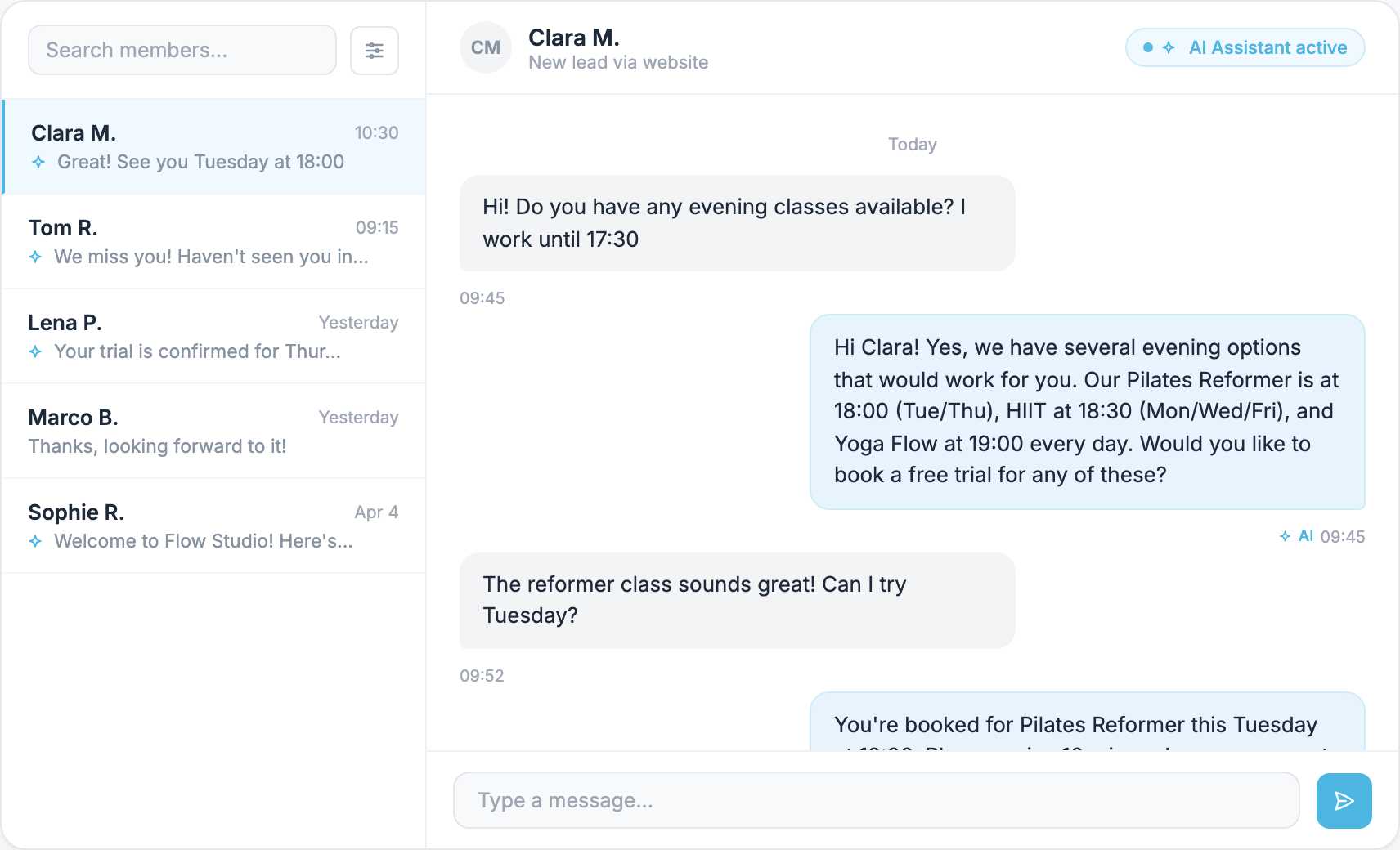
Automated, behavior-triggered messaging is the most immediately useful AI application for studios. Instead of batch email campaigns, AI sends personalized messages based on individual member behavior: a check-in after missed sessions, a welcome sequence for new joiners, a re-engagement prompt for inactive members. Strung together across the full lifecycle, these triggers let you automate the member journey so the right message reaches the right member at the right moment without anyone remembering to send it.
According to Nutripy's data, studios using an AI assistant on WhatsApp see an average of 90% of trial inquiries convert to confirmed bookings without staff intervention. The AI draws on the studio's website content and past conversation history to answer questions naturally, then proactively guides the prospect toward booking, and the quality of those replies improves when owners brief it with well-structured ChatGPT prompts for gym owners. It also follows up with payment reminders before the trial date, reducing the no-shows that plague most trial programs.
The key insight is that the AI does not need weeks of manual setup. It learns from existing content: the studio's website, prior conversations, and staff interactions. Staff keep communicating on the same channels. The result is a shared inbox where AI handles routine questions and staff step in for the conversations that need a human touch.
Signals from unstructured data
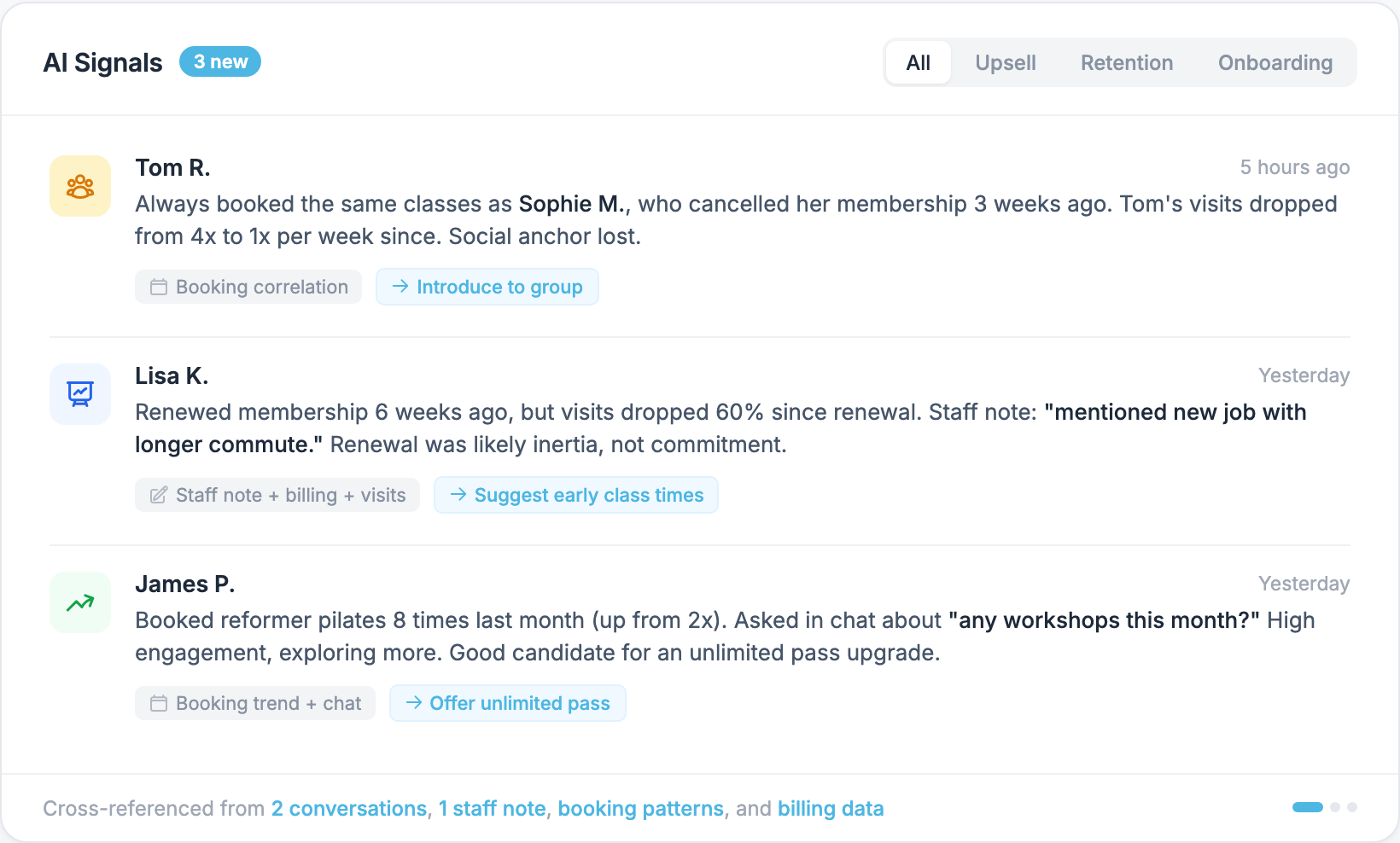
Beyond attendance alerts, some AI systems now read staff notes and conversation history to surface signals humans would miss: a member who mentioned wanting to try a new class format, or a conversation pattern that suggests someone is ready for personal training. These micro-signals turn generic "at-risk" alerts into specific actions a coach can take, like suggesting cross-training to a member who is getting bored with their routine.
This is different from traditional CRM analytics, which only works with structured data (check-ins, bookings, payments). Unstructured data, the conversations and notes that pile up in every studio, contains context that numbers alone cannot capture.
Conversational analytics
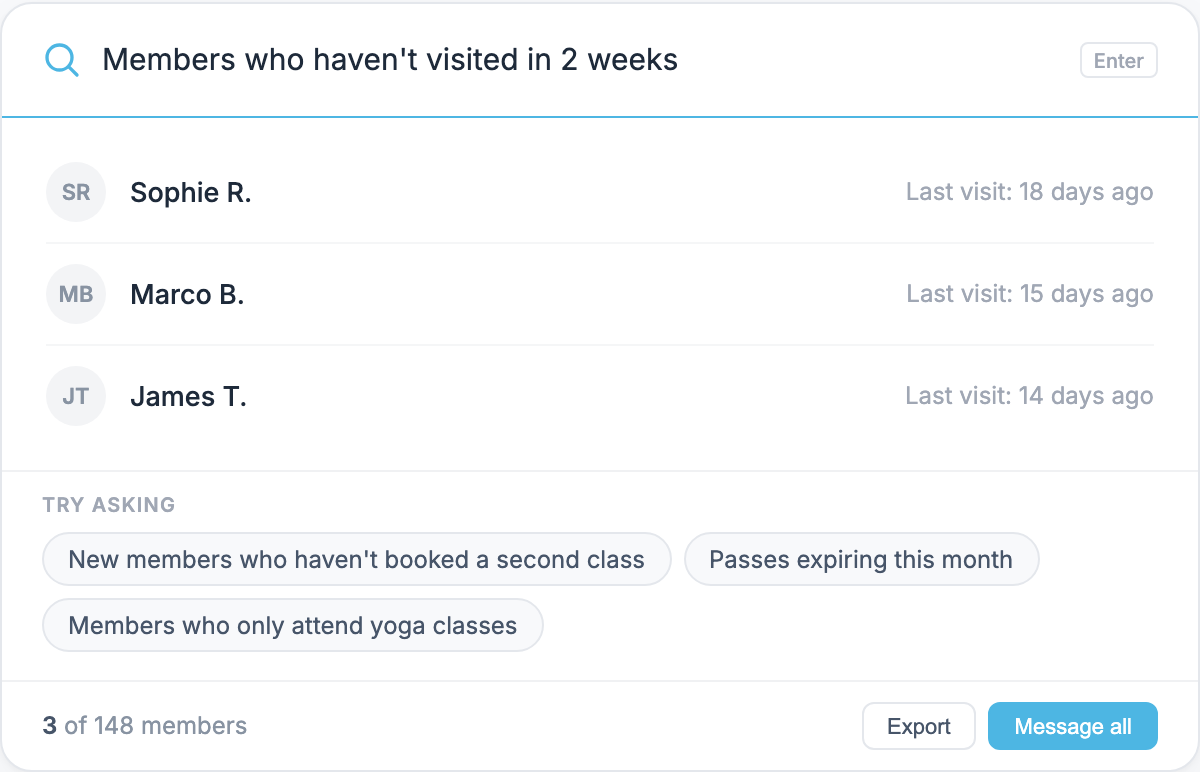
For operators drowning in dashboard tabs, conversational analytics offers a simpler path: ask a plain-language question like "which members haven't visited in two weeks?" and get a filtered list or chart without navigating reports.
The value is not just convenience. It is accessibility. Not every studio owner is comfortable building reports or interpreting dashboards. Conversational analytics lowers the skill barrier, making operational data actionable for people who run studios, not data teams.
AI on your website
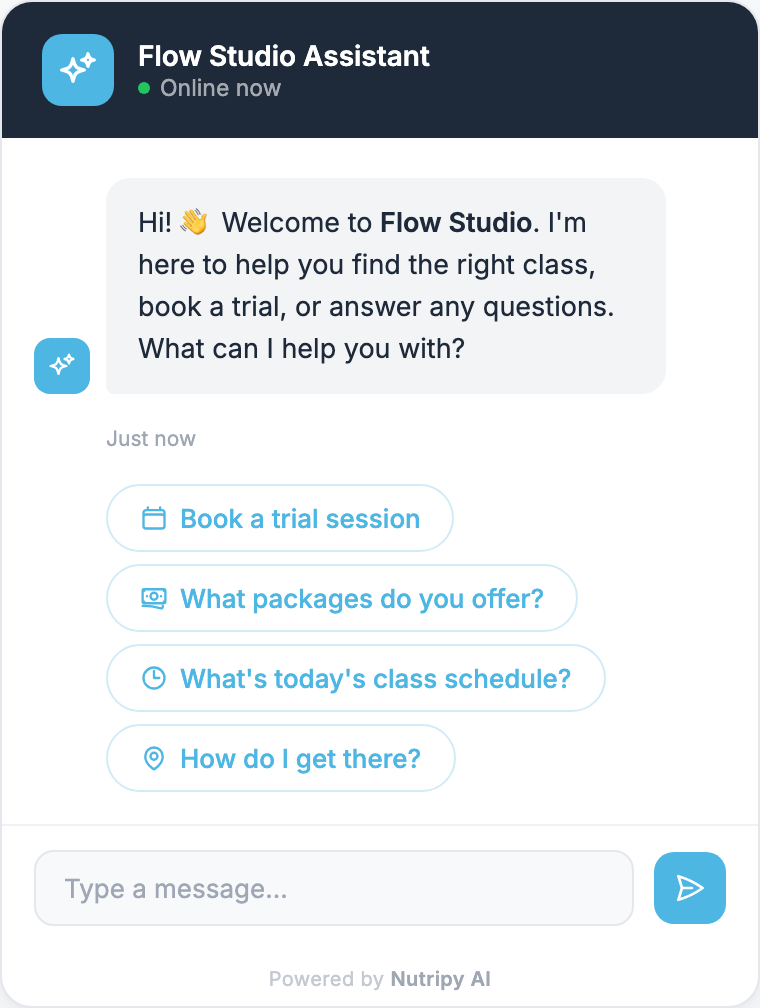
Some studios extend the same AI to a chat widget on their website, answering visitor questions and suggesting relevant services before a prospect ever picks up the phone. This captures leads at the moment of interest rather than routing them through a contact form that may not get answered for days. If you are weighing options here, our AI chatbot for gyms buyer's guide covers what to look for. The same technology can take over routine front-desk work too, acting as an AI receptionist for the front desk that books trials and answers common questions around the clock.
Where to start
Start with the workflow, not the platform. If nobody at your studio owns the follow-up process when a member stops showing up, no amount of prediction accuracy will help.
A practical starting sequence:
-
Audit your current follow-up process. When a member misses a week, does anyone notice? Who reaches out? Through what channel? If the answer is "nobody" or "it depends," start there.
-
Choose one trigger and one channel. Start with missed-session alerts via WhatsApp or SMS. One automated workflow is more valuable than a full platform you are not ready to use.
-
Use the data you already have. Your management system tracks attendance and bookings. Visit frequency is the strongest churn predictor, according to peer-reviewed research. You do not need new hardware or complex integrations.
-
Keep humans in the loop. AI drafts the message, a staff member reviews it, the member receives outreach that feels personal. In a recent ISSA survey, 52% of trainers reported using AI daily or weekly, but the consensus was clear: AI works best as a teammate, not a replacement.
-
Measure what matters. Track response rates, return-to-gym rates after outreach, and time between a member's last visit and the first automated message. These operational metrics matter more than prediction accuracy.
What to watch in 2026
Member trust and transparency. According to the same ISSA survey, 64% of trainers say their clients have never raised AI at all. Members notice silence more than automation. But 79% of fitness professionals report having to re-educate clients after they followed harmful or inaccurate AI advice. The lesson: use AI for operational outreach and scheduling, not for unsupervised fitness advice.
AI search visibility. As more prospects ask AI assistants for studio recommendations instead of scrolling search results, getting your studio surfaced in those answers is becoming its own discipline. This is where answer engine optimization for gyms comes in: structuring your content so AI tools cite your studio when someone asks for a class or a trial near them.
EU AI Act compliance. Starting August 2026, the EU AI Act makes high-risk AI system rules binding for biometric data processing. Fitness operators in Europe using AI on heart rate data, body composition scans, or facial recognition check-in will face dual GDPR and AI Act compliance obligations. If you are operating in the EU, start reviewing your data practices now, and see our practical breakdown of EU AI Act compliance for fitness businesses for what actually applies to a studio.
Terminology shifts. The industry is moving from "chatbot" to "conversational AI" and from "churn prediction" to "predictive retention." These are not just branding changes. They reflect a real shift from rigid, rule-based automation toward adaptive systems that learn from conversations and behavior patterns.
FAQ
Can AI really predict which gym members will cancel?
Yes. Peer-reviewed research shows machine learning models can predict gym member churn with roughly 92% accuracy using behavioral data. The single strongest predictor is visit frequency: members whose attendance declines are far more likely to cancel. Even simple, off-the-shelf tools can deliver strong results when fed clean attendance data.
Will my members know they are talking to AI?
Most will not notice, and many will not care. In a 2025 ISSA survey, 64% of trainers said their clients had never raised AI at all. What members notice is silence: when nobody follows up after a missed session or responds to a question. The most effective approach is AI-assisted human outreach, where AI handles the timing and initial draft, and staff review before sending.
Is AI worth it for a small studio?
Yes, but start with one workflow, not a full platform. The barrier for small studios is not budget. It is deciding who owns the follow-up process and picking one communication channel. A simple automated check-in triggered by missed sessions, sent via WhatsApp or SMS, can be more effective than a sophisticated platform nobody uses.
What about data privacy with AI member analytics?
This is a legitimate concern, and members are paying attention. Use AI on behavioral data first: attendance, bookings, class preferences. These carry lower regulatory risk than biometric data. If you operate in the EU, be aware that the EU AI Act tightens rules on biometric data processing from August 2026. Transparent consent and clear data policies are not optional.
Does AI replace personal trainers?
No. AI handles the operational tasks that trainers should not be spending time on: scheduling, follow-ups, admin messages, flagging at-risk members. Trainers remain essential for coaching, motivation, and the human connection that keeps members engaged. In the ISSA survey, 79% of trainers reported re-educating clients after they followed bad AI-generated fitness advice, proving that human expertise is irreplaceable for anything related to actual training.